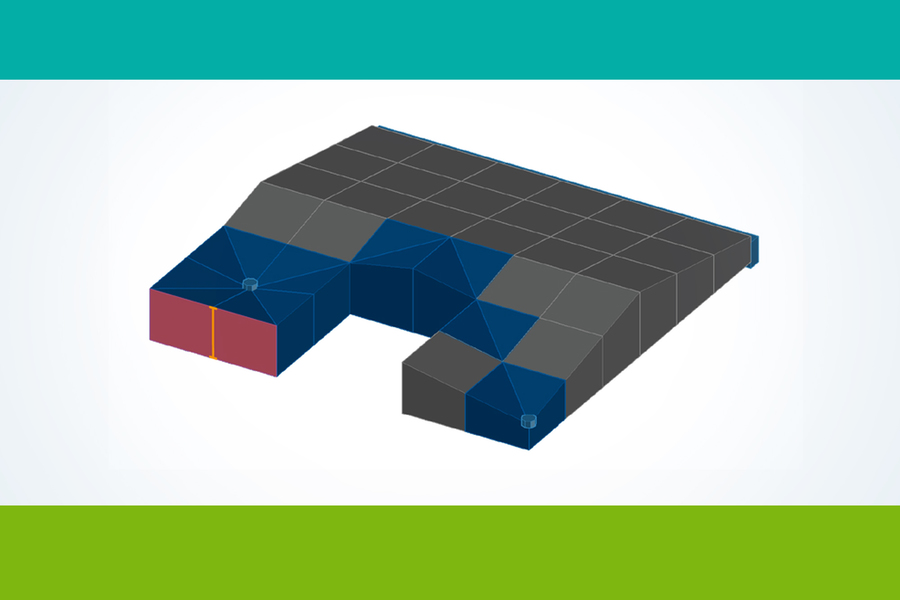
A new function is now available in the drawing tool of UDS DACH ONLINE, allowing users to precisely adjust the starting height of drainage objects. After selecting a drainage object – such as a gully or a gutter – the new ‘Adjust height’ function can be used to change the height of this object by the desired number of gradient steps.
Here’s how it works:
Select the desired drainage object. Then activate the function by ticking the box in the control panel. An input field will then appear where you can enter the desired number of gradient steps. The selected drainage object will then be raised accordingly. In the drawing, this change is made visible by displaying the steps on the drainage object.
This adjustment has an immediate effect on the entire slope logic of the roof. As the drainage points significantly determine the direction and type of slope panels, the changed starting height also influences the subsequent roof covering. This enables more precise control of the slope structure and facilitates adaptation to structural constraints.
An additional practical advantage
In certain cases, the height adjustment can also be used to specifically simplify complex or unfavourable slope layouts. If, for example, drainage points are situated at an unfavourable distance from one another, a standard configuration with the same starting height often results in an unnecessarily large number of valley and ridge rows. By selectively raising individual drainage points, the layout can be significantly streamlined and structurally simplified.
This function offers a clear advantage, particularly for more complex roof geometries or when optimising slope profiles: planners can quickly vary the elevation of individual drainage points without having to completely rebuild the roof. This makes it easier to test alternative drainage scenarios and optimise the roof covering more efficiently.
With the new height adjustment feature, UDS DACH ONLINE is expanding its drawing tool with another practical function that makes the planning of pitched roofs even more flexible and controllable.


